If there were a “purpose” toward my work on being in relationship with the horse in a new way, then it is not so much about teaching the horse to live in the human world, under our set of languages, expectations, rules, categories, culture and sport– but it is for ourselves to learn how to be with the horse in his world, to cross over, so to speak, into a world that allows the radiance of Horse Energy to outshine even our human soul, and to dip into that stream of pure joy and exuberance which is the natural essence of Horse Spirit. My stallion Khemancho, is teaching me how to be with him there, and I can tell you — its pure joy – both horse and human being completely unbridled — becomes a dance beyond words.
Here, anyway, is what it looked like yesterday. At one point in the video I step backwards and fall on my fanny. ChoCho is so tuned into me, he thinks it is a “new move” and tries to lay his fanny down in the snow, too. WHAT A HOOT!
The pages in this section contain video of a session working with developing softness in this impressive gelding. This horse had on several occasions injured his owner, and it was easy to see how effective he was in using his shoulders to push on and into people, while expressing threatening gestures with pin backed ears and threatening to bite.
In developing softness, it is crucial that you yourself are always and consistently soft. One cannot develop softness in the horse by carrying on with what I call “instructor dominance.” Instructor dominance assumes the role of the human is to command, and the role of the horse is to obey. This particular horse, having a noble character, tremendous sense of self, and absolutely no fear, is understandably averse to this notion.
In addition, his bracing and pushing tendencies have been interpreted by instructors as a tendency toward dominance and aggression. These are not useful terms. A horse is always a horse in context. In the context of instructor dominance, the horse appears dominant. The instructor then reacts to this category and becomes more dominant in her approach. The horse and the instructor become locked into an action-reaction cycle of dominance and aggression (and fear on the part of the human).
One should never approach a horse in this way. To build softness, one must be the movement you want to see in your horse. You approach, your body language, your emotions, must all be of a whole movement– that of lightness and softness. How to do this in the presence of a horse whose default behavior looks like aggression, is the subject of these videos.
Getting to Know: Two Beings in a Field of Relations
In the first video I examine the horse’s default response and levels of aversion to pressure on his shoulders, by feeling into the level of his reactions to 1) the directness of my approach, 2) using my body language to “push” on his shoulders, 3) using my hands to pressure his shoulders, 4) using the rope to signal the shoulders.
You can easily see the horse’s default behavior, and why people jump to the assumption that this horse is dominant/ aggressive.
Rather, think of this as a dance, with a certain kind of energy flowing in both directions, and two beings feeling into each other. Despite what it looks like to the untrained eye, to the person who is both dominant and/ or fearful, the dance has already begun.
It is important to note how I begin to make large circles around the horse each time I prepare to approach. This builds relationship in the horse– it is natural bonding language. Unlike the conventional “instructors dominant” approach, wherein the instructor drives from the center of the circle, this approach invites the horse to partner in a kind of dance of equals, where there is not one direction only (I say, you do) but two beings in a field of relations.
In the last part of the video, I am allowing the horse to investigate me, in the same way I investigate him. By allowing him to feel into my energy, which despite his advances, and one timely “threat” gesture, I keep soft to him. Consequently, there are not action-reaction cycles in our interaction.
It is crucial to note: Softness is not fear. A person filled with fear cannot be soft to the horse, just as a horse filled with fear cannot be soft to a person.
Finding Lightness Through Movement
The horse starts off in his usual manner, bracing toward me, with an “aggressive” posture. My approach does not change. I use the rope to key his left shoulder, and the movement instantly changes to and outside spin with impressive lightness. The habitual bracing is being released. No horse intent on bracing in the front would execute this maneuver in the opposite direction which such seamless grace and lightness. I accept his gesture as we share a moment of mutual admiration and respect.
Starting to Dance
In this footage, the horse is invited to dance through correct body position. Unlike conventional “instructor dominance” approach, I do not drive the horse from the center of a “circle of safety and control”– rather, I take position on the circle the horse draws out for us, and become the movement I want to see. In this simple way, we enjoy a deeply profound connection through the joy of movement, while continuing to feel into and experience the boundaries of our individual energies.
The horse is transforming into softness, performing graceful circles with me. He begins to become so light in the shoulders, that I can cue a graceful and seamless outside turn with a gentle signal of my wrist, hand and pelvis.
The horse takes up this dance from an innate sense of joy in movement and engagement. There is no pressure to perform, to do the “right” thing; there is no duty expected, nor any orders from a “command and control center.” There is only my continual invitation toward the direction a horse naturally seeks.
Precise & Coherent Body Language
Pictures are worth a thousand words, and video is even better in slow motion. But in my experience, people have to be trained to see in entirely new ways in order to improve their relationship with their horses and develop enlightened ways to engage with the horse. The following is a slow motion video of the beginning of the dance between these two beings. Since the horse is such a perceptive being, one’s body language must be precise and coherent. Over and over again I see people trying to relax their horses when they themselves are fraught with fear; trying to create softness in their horses from a position of command and control; trying to bribe their horses for friendship — these are emotional inconguences that the horse rejects. In addition, there are so many body language incongruences given by people, because they have lost their natural ability to move coherently, due to improper instruction by others. See if you can notice in the video the following:
How the rope communicates softness.
How I take up the position of the circle that the horse draws, and thereafter, he takes up the circle that my hips are defining by the way my legs cross over in the front.
How I “draw” the horse into me through a subtle curvature of the center of my body in my lower belly.
How the horse becomes my movement, as I maintain the movement I want to see in him.
How there is the complete absence of any action-reaction cycle.
How there is no one absolute direction of A leading B or B leading A.
That the movement in the horse becomes expressive, light, soft, and even moreso– curious, adventuresome, always leaning into the next moment with enthusiasm and curiosity.
The body language of mutual respect.
I would like to introduce the horse character ‘The Minister’ as described in Klaus Hempfling’s book What Horses Reveal — as it applies perfectly to me. First you must know that Klaus has assigned the character groups not only based on their inner natures, but also based on the insight that our outer form and conformation “conforms” to the basic being we are on the inside– nature and form, form and nature, are merely two aspects of the same being. Of course, this insight requires a skillful eye — the basic form of a horse cannot be derived from the pieces and parts alone, but there is also a kind of overall “gestalt” to the horse’s formal features and conformations that “reveal” themselves to the perceptive person. This is so true of so many horses that it can be uncanny, once you start to do some investigation. Take me, for example. I am the quintessential ‘Minister’, according to Klaus’ description (even if I say so myself). Here is what Klaus says of this type:
Of all horses, the Minister is the most mentally agile, the cleverest. He is very superior in his nature. He is a wise horse, and one that you would gladly ‘turn to for advice.’ As a rule the owners of such an animal do not, by a long stretch, measure up to the inner abilities of the horse in terms of awareness, directness, honesty, clarity, thgouhtfulness, peace and purpose. The horse then knows only too well that, with regard to these qualities, he is a long way ahead of his human, which can lead to difficult situations. He learns extraordinarily quickly and is only too ready to take on and master these new challenges. A child’s genuine down-to-earth attitude and agility make it surprisingly easy for him to approach this horse. This Minister loves children because they are so much more like him than the adults.
Here is the representative portrait of the Minister in Klaus’ book. You can see from his body type, head, and basic energetic movement, that he is just like me!
Klaus goes on to describe the right kind of person for a horse like me. He writes:
If the Minister feels that he can encounter a person on the same plane then he will be the first to tear down every barrier between human and horse. Overall, he is the most open type of all horses but he is also the one who can quickly hide himself, or even entrench himself behind a wall of feigned ignorance: he will pretend not to understand. The Minister is a wise horse and he seeks wisdom in human beings and, ultimately, the Minister can only accept a fine, high-ranking person of strong character. In fact, he is the most exacting when it comes to the selection of a suitable person. For that reason the Minister often feels very ill at ease in the world of human beings since this world, particularly these days, and particularly the riding world, is not exactly liberally sprinkled with wisdom and nobility.
You can see for these reasons, how difficult it was for me to be born at a racing track where I was completely misunderstood, and no one could recognize me until my new owner rescued me and took me in –that was over 25 years ago! I was still confused and skeptical about the human world, but I immediately recognized a soul-mate when we first met and our hearts touched as she reached out to me with love, affection, gratitude and a tremendous sense of hope for our life together. Here is a photo of that first and most important encounter
You can see how unsure of myself I look as a 4 year old. But just one year later I had grown to be athletic and confident as you can see in this second photo.
Here we are together just one year after meeting up. We were a very tenacious pair, galloping through the fields and mountains. Those were fantastic days. But my real nature as a Minister unfolded gradually. Due to my early years and problems with my feet, I did not hold up well under competition. I happily retired to a large farm for many years where I got to see my horse herd grow into the 8-member family we are today. Here is a photo of my best years on the farm at Spring Hill.
Today I am 30 years old! Now I teach workshops to humans, inviting them into the wisdom and heart-space that I try to share with them by opening up my own inner nature for them to experience. My outer form is not so rugged and handsome any longer, but my inner spirit has been allowed to manifest in very open and significant ways, thanks to the great fortune of having found the “right” person. I am now a true Minister, as the human world is my “Ministry” which I happily and whole-heartedly embrace. Here is a photo of me, now on the lawn at Alderlore, my home:
It is important for humans to be able to know us on a deeper level if they want to cultivate joy with us. It is necessary to understand what joy is, what does joy feel like, and what does it look like in different horses. When a horse is allowed to express her true nature, there is joy. It is like the ducks we have at the farm. Every day they enjoy their ducky nature, which is diving into the pond and eating mud. That certainly would not be joyful for a horse! Neither do we like a lot of human -centric activities, or even human type comforts. We want, foremost, to enjoy our equine natures. Beyond that, different types of horses — the different horse characters — express joy in different ways. Humans cannot expect us to be joyful, when what you are asking us to do is against our most authentic nature! Take me, for instance, I’m Gypsie, the one up front in this photo. I type as the” Prince”. I like to set clear rules. I like to lead. Jhana (in the background) types as the Sargeant. She likes to follow clear rules. That makes us a perfect pair. It is no coincidence that we run the ring the way we do, me on the inside focused on the trainer, while Jhana shadows me like a loyal companion.
If you didn’t recognize us, you might expect that I was bold, and Jhana timid, but it is not as simplistic as that. When something scary happens, something that scares us both, Jhana takes over the lead, and confronts the ‘scary unknown’ in a very bold and agressive way, which allows me to take flight to a safe distance, and peruse the situation, and call out orders, if necessary.
We work as a team. There is no permanent “dominator”, as some humans like to imagine.
When Jhana had her babies, she turned them over to me for “lessons”. But the babies softened me, and I really spoil them too much. Let the humans around here take on their training! I’m learning to love life in my middle age.
So the point of this post — Cultivating the Joyful Horse — is that it requires humans not to project what joy should look like in this case or that — since what it looks like is different for different horse characters, and also changes as the situation changes. What is joyful to a horse of the type “Friend” is not at all the same as what is joyful for “the Tough One” or “the Victor”.
Joyfulness comes from the freedom and capacity to express one’s authentic nature. We recognize joy as enthusiasm. The capacity for joy is also dependent on the health of the horse, age, and training. Human can help cultivate joy and joyful relationships with us, by knowing our horsey nature, by recognizing our individual natures (character/ type) and by helping us stay healthy at all ages, and training our bodies to have the capacity to express our freedom and our joy. Humans can cultivate joy in themselves and learn what joy truly feels like. Then they can recognize horses on a very deep level, where the joyful energy arises in us. This is nature’s gift to horses.
In 2009 Alderlore will present a 5-day clinic on Cultivating the Joyful Horse for humans and their horses. Check our website in March for further details www.alderlore.org
Hm, this is fascinating. Can’t wait to see the types…as for what type am I? A good observer with a love of studying pattern, movement, color and form; a bit solitary; delighting in small details; very visual. But also prone to impatience and anger, though I tend to anger very slowly and not express it immediately.
My old horse had an opinion about me yesterday, when I left her tied to the arena wall and rode another horse first. She spent the whole time glaring at me and trying to untie the rope with her teeth.
Your description of yourself aligns with the nature of the Sergeant archetype. Here at Alderlore Mehrjhana is our Sergeant.
The Sergeant is razor sharp, fiery, independent, fast, hardy, generally healthy, fairness-loving, exceptional horse, still wild in his nature, and mostly fixated on one particular person. … his whole nature is marked by a joyful clever competence and practical common sense.
The Sergeant can become very unpleasant when he is with people who are indecisive and cannot communicate the sense of their actions without confusion. Then he becomes the commander, the boss, and with full force. … The Sergeant senses great abilities in herself, and does posses them, but is thoroughly content with a secondary or subordinate position.
The Sergeant will go through thick and thin with his human, possessing both severity and inner robustness.
If the Sergeant does not have a clear relationship with a person, then he can sometimes become aggressive. He will soon feel lonely and abandoned, and then develop a rebellious nature, finally retreating further and further into himself in sadness.
If this human finds the right horse counterpart– a strong, self-confident humanhorson who strives for fairness, order, and proportion, who wants to be schooled, can be shown the world, and can give him a lot of time– the Sergeant can give this person a wonderful insight into the freedom that horses carry within themselves. For the right horse, there is much joy to be found with this person.
Hello friends (horses and humans alike). I want to talk about what kind of horse a person is (or what kind of human a horse is) either way, the gist remains the same. I have found that there are many types of humans just like there are many types of horses. Of course, each human as well as each horse is unique in his or her very own way, but there are general characteristics that show up, if we are careful enough to watch body language, or feel into the energy, that can be categorized into types.
Horses are often typed according to what we are best at, whether that be draft, sport, companion types. Further character types appear within the breeds that fit those categories, such that, for example, both a thoroughbred, quarter horse, morgan and arabian are all considered sport horses, but the kinds of sports they are best at are different.
But that is not the type I am really interested in. I am interested in the type of character of the person, or the horse– the attitude and energy make-up of them. This is important when humans are deciding on what type of horse suits them bests; and for us horses, it is important for us to understand a person on a very deep level. We are always trying to help humans understand themselves on this deeper level– to understand what type of horse they are– so we can meet at the origin of spirit energy– which is deep joy. This deep joy perfects the horse-human relationship in all kinds of important and thrilling ways!
Over the next few days we will look at various general types of horses and humans, and how they can best understand how to work together for the benefit of both!
In the meantime, why don’t you take some time to size yourself up? What are your basic emotions? What are your most fundamental feelings, deep down where there is a kind of secret in your heart? What is most true about your self? What are your dreams like?
You can also ask your horse these questions. You can even ask your horse’s opinion about your self!
Welcome to the blog of The Horses at Alderlore. The stallion, Khemancho, is our masthead, but you will hear from all of us on occassion (some of us being more communicative than others). If you want to track posts by any of us in particular, just use the Tag cloud at the right.


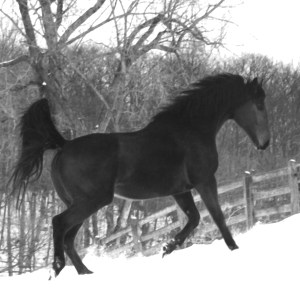 I would like to introduce the horse character ‘The Minister’ as described in Klaus Hempfling’s book What Horses Reveal — as it applies perfectly to me. First you must know that Klaus has assigned the character groups not only based on their inner natures, but also based on the insight that our outer form and conformation “conforms” to the basic being we are on the inside– nature and form, form and nature, are merely two aspects of the same being. Of course, this insight requires a skillful eye — the basic form of a horse cannot be derived from the pieces and parts alone, but there is also a kind of overall “gestalt” to the horse’s formal features and conformations that “reveal” themselves to the perceptive person. This is so true of so many horses that it can be uncanny, once you start to do some investigation. Take me, for example. I am the quintessential ‘Minister’, according to Klaus’ description (even if I say so myself). Here is what Klaus says of this type:
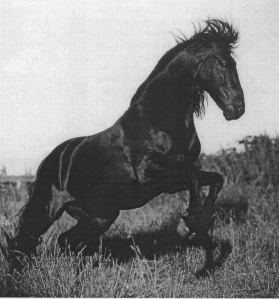 Klaus goes on to describe the right kind of person for a horse like me. He writes:
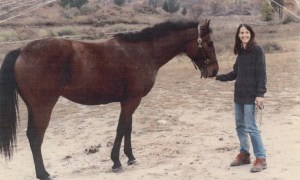 You can see how unsure of myself I look as a 4 year old. But just one year later I had grown to be athletic and confident as you can see in this second photo.
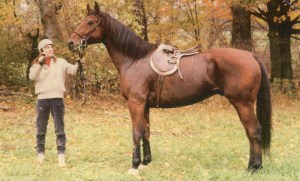 Here we are together just one year after meeting up. We were a very tenacious pair, galloping through the fields and mountains. Those were fantastic days. But my real nature as a Minister unfolded gradually. Due to my early years and problems with my feet, I did not hold up well under competition. I happily retired to a large farm for many years where I got to see my horse herd grow into the 8-member family we are today. Here is a photo of my best years on the farm at Spring Hill.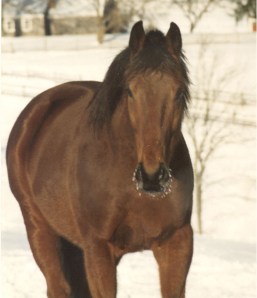
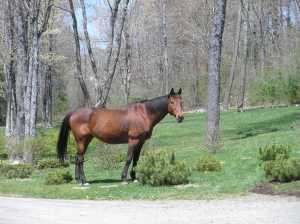
 It is important for humans to be able to know us on a deeper level if they want to cultivate joy with us. It is necessary to understand what joy is, what does joy feel like, and what does it look like in different horses. When a horse is allowed to express her true nature, there is joy. It is like the ducks we have at the farm. Every day they enjoy their ducky nature, which is diving into the pond and eating mud. That certainly would not be joyful for a horse! Neither do we like a lot of human -centric activities, or even human type comforts. We want, foremost, to enjoy our equine natures. Beyond that, different types of horses — the different horse characters — express joy in different ways. Humans cannot expect us to be joyful, when what you are asking us to do is against our most authentic nature! Take me, for instance, I’m Gypsie, the one up front in this photo. I type as the” Prince”. I like to set clear rules. I like to lead. Jhana (in the background) types as the Sargeant. She likes to follow clear rules. That makes us a perfect pair. It is no coincidence that we run the ring the way we do, me on the inside focused on the trainer, while Jhana shadows me like a loyal companion.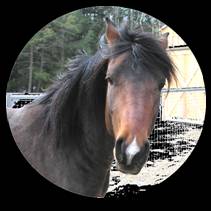
 The Horses at Alderlore Present