Our current challenge takes us out of the paddock, out of the ring, and onto the road! Well, not really, as we are starting with the driveway entrance to the house. The mares all scream for ChoCho, and it is terribly difficult for him to stay focussed. Here we are just watching and trying to remain as still as possible. You can see with what intensity he is observing the horses way down in the paddock. Hard to be a stallion.
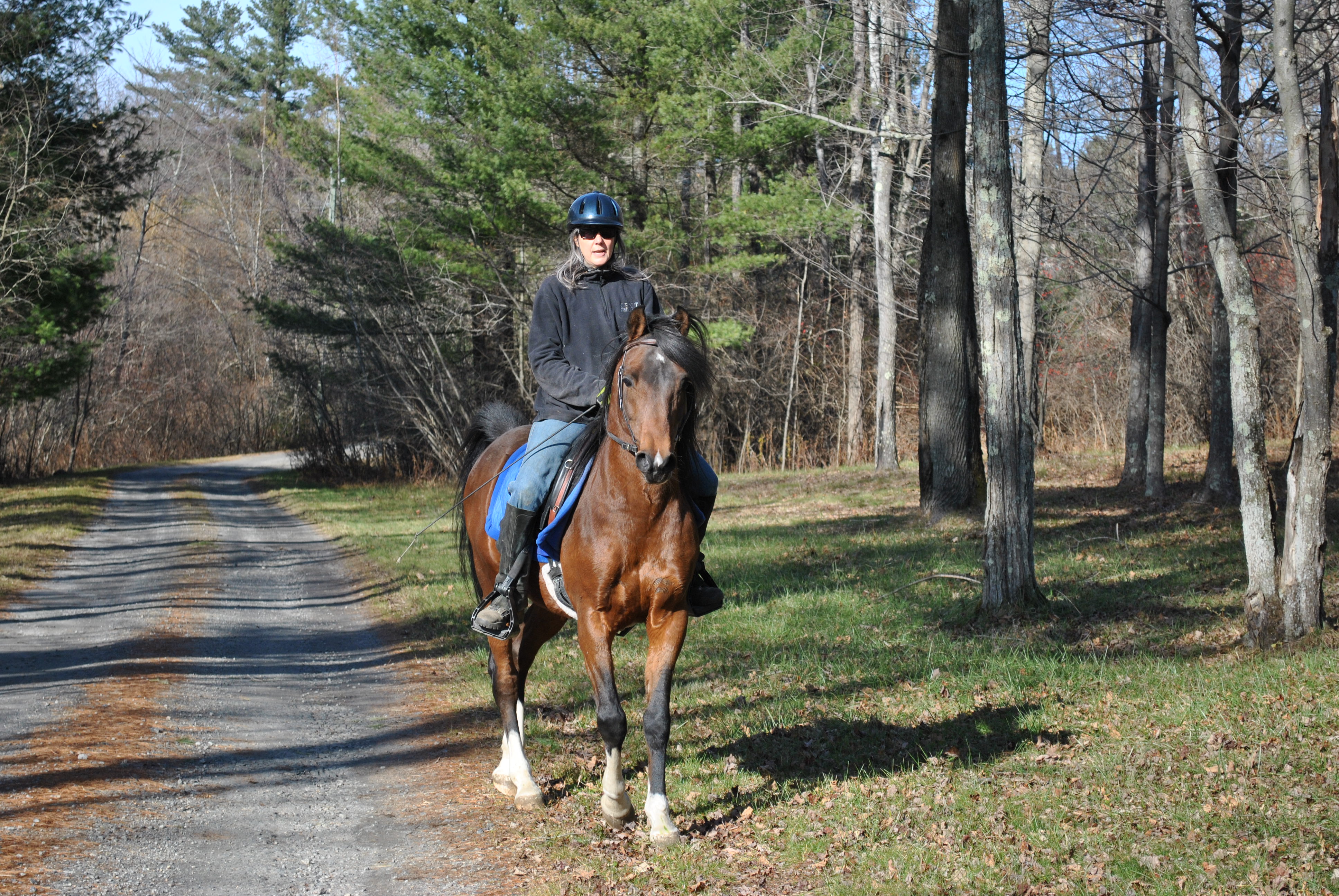
I just love this photo of me and Khemancho coming back from a ride this Sunday. It summarizes a lot that could be said about connection and joy (after a good work out!).
This weekend was unusually warm and inviting for November, so the stallion Khemancho and I played around in the back paddock, practicing rolling our weight back, doing some lateral work, and swinging around the forehand. ChoCho was really listening to the corrections – but as you can see, he is comfortable with making suggestions and asking questions himself. As in all my practicing videos — they are certainly not meant to teach anyone a method or an approach. I am myself just learning, too. I hope that sharing our journey together will encourage you at the stage you are at with your horse — and to remind you how fun the journey can be for both horse and rider, regardless of the “progress” made or not made.
This blog has become lately a kind of diary of my practice with the horses. ChoCho and I have been taking riding lessons on the occassional Saturday with Margaret Beeman. She is a professional trainer, specializing in colt starting. ChoCho did 3 months of basic training with her 2 years ago. You can see his final day “at first grade” with Margaret in this video:
ChoCho was younger then, but between the hands and legs of such an experienced rider, he goes through his gaits smoothly, considering he had just 3 months with her — one of which is all ground work.
ChoCho is obviously much more matured, both physically and mentally. I, on the other hand, am just starting basic training in dressage. So sometimes ChoCho has to work uphill with me, although he never gets negative feedback when we don’t get it all quite “right”. We (ChoCho and I) try to enjoy the ride, not the outcome, the process, not the product. Anyway, here are three clips of our latest “homework” — our video report back to Margaret about our “relative progress” on the path. The path to what? I don’t know. It doesn’t really matter. We had fun Saturday. Thanks to Sandy, we get to share it here on video “tape”.
Please note: This video is certainly not an educational piece on how to ride the canter! I constantly check my own balance and posting laterals. And am still working on a decent seat. Also, I am intentionally opening my hands and reins out on occassion, to ake sure that I am not hanging on ChoCho’s mouth, nor is he hanging o my hands, to leverage at the canter. Let me know what you think. However, amateurish, I think ChoCho is handsome. A fine gentleman. And yes, at the end, he walks straight to the camera to ham himself to the audience. He is priceless and I love him beyond words.
These August days have been brilliant and hot. I have been quite lazy, and that seems to suit the horses, too. We practice in a light and playful spirit. We take videos with a little flip camera and post them right onto youtube without editing. Everything is kept simple and short. As always, we look for softness in our hearts, in our minds, in our bodies.
Here are two short clips of ChoCho and me learning a new dance step. It’s basically a pirouette in opposite directions. The key for him is to distinguish the “turn, face and stop” cue from the “keep going I’m spinning” cue. The key for me is to keep my body language precise. We didn’t practice before getting out the video. We just pointed and shot in real time.
The first clip is our practice run with a long line/ neck rope. The second clip we do it truly at liberty– with no rope attached. Enjoy.
For those of you who don’t know – Khemancho and I have been taking dressage lessons. My actual teacher/ trainer is Margaret Beeman, who started Khemancho as a 3 year old colt 3 years ago. (How time flies!). You can see her work here. Although I have never met her, I also consider Karen Rohlf a teacher, since I have spent hours and hours studying her DVD and book training series. You can read about Karen at Dressage, Naturally. My “goal” in dressage is not only to do what ChoCho seems born to do and loves to do! (I had expected him to be an endurance horse since he comes from Belesemo Arabians, who breed endurance horses, and he has full siblings who are endurance champions) –I had never ridden in a ring before I started with a dozen or so dressage lessons last fall- – but my goals are to execute/train at dressage in ways that are consistent with my interest in cultivating the soft and joyful horse. I am learning a lot! And in some ways I feel that here is where the rubber meets the road, where the proof is in the pudding, where we get to walk the talk (how’s that for a string of euphemisms). Last week ChoCho worked at a lovely trot, and also offered what Karen Rohlf terms “the let loose posture” — which is the foundation of balance and softness, upon which collection can be correctly (that is biomechanically) built.
Let’s go to the video tape:
Here we are trotting a simple figure eight
Here ChoCho is offering the “let loose” posture at the trot:
We have deep snow in the back paddock. Yesterday we played “go trot and come” in the snow with ChoCho. His version of this Waterhole Ritual of Carolyn Resnicks, is quite lively and dandy. Enjoy his youthful stallion-ness.
Yesterday I had my chance to put into practice an idea I had about waltzing with ChoCho. Here is a video of our first trial run with music on the line, and then a short piece we did to music under saddle.
Yesterday was a beautiful Autum day. It was Sandy’s birthday. I took the day off, and Sandy, Amy and I trailered ChoCho and Hootch over to the horse park, Steep Rock. Hootch (the quarterhorse paint) thought it was a perfect day for relaxing. ChoCho & I took advantage of the rare opportunity for a good open space for him to race around in the sun, and celebrate his power, agility, grace & spirit… > Let’s go to the video tape!
This is something I say and write over and over again:
The Rider has No Right to the Horse’s Head!
Recently I have been asked by Kim over at enlightenedhorsemanship.net to expound on this in my own post. So here goes.
I believe that a person has no right to a horse’s head. The tendency for people to focus on the horse’s head, rather than on his body and feet, is engrained in both horsepeople and non-horsepeople alike. In workshops on liberty training, I teach the importance of precise body language. When trying to move the horse in one direction or another, too many people concentrate on the horse’s head — waving their hands at the horse’s nose and face, instead of thinking about how the horse’s body needs to move, and using your own body expressively in a manner that communicates this.
When riding, the situation becomes more exasperated, since too many people (like myself) have learned the wrong kind of “equitation.” There is too much talk about getting the right “look” at the poll, instead of understanding what the horse needs to be doing with his body. To me this is the same as as if a trainer had seen beautiful ballet at the theatre, and then began teaching ballet by using bungi cords suspended from the rafters to teach students how to achieve the rising and swirling of the head. The cause and the effect are mixed up. The ballerina’s head rises and swirls as an effect of what her legs and body are doing.
Similarly, head carriage in a high-schooled horse, should be an effect of proper conditioning and training of the horse’s feet, back, and body. This is the teaching that the student requires:
Setting the head with the bit, reins, and other technologies, and forcing the horse into a frame, quickly injures the horse’s neck, back, and spirit. The work is painful and disheartening to the horse. The result is a fictionalized illusion of classical dressage — however many points the student amasses at the shows.
What then is the relationship between the horse’s legs and his head carriage in early schooling? On the lunge, the trainer helps developi the horse’s balance at the various gates, primarily by focussing on the inside hind leg and driving the momentum from that leg through the loins, back and forehand. The stronger and more supple the horse becomes, the more the inside hind leg tracks forward in a balanced way, liberating the forehand to take a long, low stride. As the stride develops power, impulsion and freedom (the opposite of forced frame) — the loin actually travels up from under the horse– and therefore, the poll rises freely.
The horse’s enthusiasm for the work is developed through cultivating his balance and freedom!
At the trot it illustrates like this: (train yourself to watch the inside hind leg- which is the one “closest” to you – as it travels more and more forward, liberating the forehand, and allowing the head to rise naturally):
Here is an excellent video of Klaus Hempfling and his stallion over time, developing carriage through body language.
Few of us have the talent to work exclusively with a horse this way. We rely on bits and other aids — being as soft as possible to communicate to the horse what to do with his feet. The inside rein works in rhythm with the inside hind leg, to create impulsion. At the rising trot, the rider rises in sync with the inside hind leg pushinc off and coming forward — to liberate the leg to come underneath. The horse is worked at a extended pace, and reaches for the bit as if it were in front of him. Working with a horse this way, you can feel him trying to find the “sweet spot” — that place of rhythm and balance which eludes the young horse. When the horse finds the “sweet spot”, it all comes together in a very liberating feeling. It produces joy in the horse and rider.
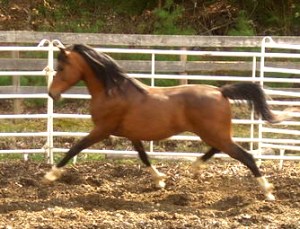
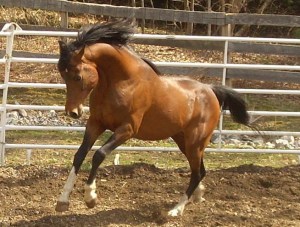
Here is a picture of my stallion, Khemancho at liberty. This is a nice trot for a young, unschooled horse. The second picture shows his natural classic carriage – as he brings his loins right up underneath himself.
Under saddle it’s much more difficult for him, since he is still learning, and I am starting over myself hopefully with “Beginner’s Mind.”
Finally, here is a slideshow of Klaus and another stallion, that demonstrates the development of carriage. Watch for that inside hind leg, and see how the horse composes himself over time. This is exceptional for any horse to achieve. Why so many people burden their horse with the expectation of quick results, facilitated by an illusion based on force…. is a really good question.


 The Horses at Alderlore Present