A Freisian’s Journey on the Path I (3)

Because some of the slow, intense and close work can build up tension in a horse like this, after his break, I decide to work at greater speed with a greater sense of space and liberty. Ideally, the horse should move enthusiastically and joyfully. This requires the horse to release his tension and braci-ness. At first I send him in a circle, with more energy and enthusiasm than I showed previously. Without proper understanding from the intitial work, a bracing horse might just become more tense when you add more action to the request. The Freisian moves rather nicely, first yeilding his right hindquarter to circle clockwise; then I reverse him by asking for the shoulder to yield, and immediately turn to work on the left hindquarter as he comes off the rail.

Now something peculiar happens. He comes off the rail rather willingly, but in this session I am asking for more enthusiasm, so I throw the rope to touch his left hindquater, and the horse is somewhat startled into attention. This causes the following reactions

1. He counters by bracing in the right shoulder and right hindquarter at the same time.
2. He throws his left hindquarter out into a brace.
3. With his left side braced, the right side in a sense “falls into” his left side, and he stumbles sideways.

The good news is that the horse moves off of this blunder rather softly by first, releasing the bracing in his left, and then yielding nicely in the hindquarter– which is what was asked of him at the beginning of the sequence.

The entire episode seems to have brought up some of the natural enthusiasm of the horse, as he breaks into a canter from an expressive trot in a balanced and entusiastic way along the far rail. You can hear his owner’s happiness at witnessing this. You will then see he trots nicely down the near (right rail) since he is now working without tension and bracing.

When he stops and I approach, his habit returns, and he turns away from me, bracing with the left hindquarter. He is quite insistent on keeping this between me and him, and so I turn him by moving his right shoulder couterclockwise– which exposes his left hindquarter to me, without getting into a fight or fuss over anything. It all happens quite naturally and effortlessly. This is at 1:36-1:49 in the clip. As he moves off, you can now see me alternating back and forth between the hindquarter and the shoulder, so the Freisian doesn’t “rest” on a braced limb. A few trots later, he again braces in the left hindquarter, so I once again turn him with implied pressure on his right shoulder, once again, exposing the bracing left hindquarter. The next move is wonderfully soft– as all the bracing disappears from the left hindquarter, and the horse moves gently and softly to face me.

He trots off to the rail, and there is a sense of bracing in the left hindquarter– which is his habit when he puts himself on the near (right rail). But happily he turns softly by yielding off the rail to face me. A real breakthrough! which he repeats as I approach him an turn him around, completely off and parallel to the rail.

I end with an experiment of putting implied pressure directly in front of him– which the horse did not respond to.

A Freisian’s Journey on the Path I (2)

In this next clip, the Freisian starts off along the rail braced in the left hind as before. Still, he moves rather nicely off the rail when I ask him to yield the left hind. From then on, as long as you see him move in a circle around me, rather than straight away, he continues to yield and be soft in the left hind. I then move toward working on the inside shoulder, for a soft outward-going turn, which positions me to work on the right hindquarter which he also yields very nicely. Soon he is soft and focussed in his work– and gets good praise and a deserved break.

A Freisian’s Journey on the Path I

In this first segment, I am looking to allow the horse space and time to accomodate my approach. If he is attentive to me without bracing (a soft turn of the neck) I leave him and circle again. His natural tendency to like people, keeps him engaged with me. His habit of bracing, pushes me away. There is a back-and-forth/ give-and-take kind of dance going on.

You can see his tail switching during my approaches. This is a subtle signal that the hindquarter will brace from any pressure (such as my intention) placed on it. Once he moves forward from me, he positions himself against the rail, and braces with his left hindquarter — notice the angle he takes to keep the hip positioned to back me off of him. This then becomes the focus of the events that follow — to release the bracing in the left hindquarter. But I do not take offense at this, nor do I seek to punish the bracing. My attitude is soft and focussed — just the same as the behavior I want to see in the horse. I must BE the behavior I want to see in the horse. Therefore, I take up his bracing as an “offer” — as if I had asked “and what would you like to work on now?” — and he had answered “how about this bracing hindquarter– see how it braces so.” He nicely moves off the rail by bending through the hindquarter.

If you look closely, you might also see why this horse presents unusual difficulties in his training program. As he releases in the hindquarter, he braces in the shoulder. Therefore I work on alternating between the shoulder and the hindquarter.

My intention, attitude, body position — espeically the position and angle of my own shoulder and hips — are all crucial in this work — I must not pose a problem to this horse, who needs his confidence built up piece by piece, from one small and brilliant success to another.

Here is part 1 of our first session:

The Dancer

I am having an extraordinary encounter with a Friesian gelding and his owner. Although he is lucky to have his current owner who is patient and loyal and concerned about his development, for some reason, life has not allowed his innermost nature to flourish and express his innermost joys. For some reason, the opposite has occurred– he had become tense, with all four limbs bracing independently, with an exaggerated tenseness in his neck; he had become frustrated and hard to reach, and although he clings to his owner for protection, his eradic behaviors — bracing, bolting, and jumping into her lap — had made him dangerous to her. He had been “pshychologized” as both fearful and dominant, and the truth is he did make one feel like he was trying to react with both fight and flight responses at the same time, which increased the incredible tension in him. Now that I know him better, overall there is a sense of complete lack of confidence. He does, however, have a good solid heart, and a tremendous strive to improve– although he lacks a sense of what direction “improvement” lies. Therefore, it is important, as will all horses, to build on his assets, rather than “attack” his defects directly. His assets are his heart, his will, and his general clinging to people he trusts.

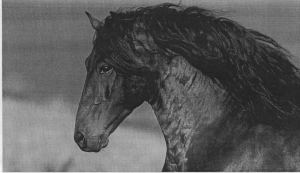
This Friesian types in Klaus’ work as The Dancer.
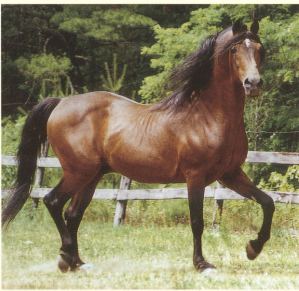
dancer

Of The Dancer‘s nature, Klaus writes:

As a rule this type of horse is highly intelligent and cery creative, which means that he is not a beginner’s horse. This horse has a very friendly and sensitive nature. He is clinging, uncomplicated and loveable in his approach to human beings. Generally, the Dancer is curious, loves to move, and is very willing to work. Despite his appearance and the name I have given him, this horse often has problems with his gaits because of the weakness of his back. Naturally his gaits are far more expressive than those of other types. However, the truly relaxed, rhythmic, powerful, gracefull expressions in movement, which you associate with a dancer, are usually lacking.

Like Klaus’ Dancer, this Friesian has difficulty making strides that come from impusion through the back. This is probably the basic misunderstanding that has lead to this horse’s downfall– the unwillingness of trainers to design practices that accomodate the central conformational aspect of his nature. His naturally expressive and artistic gaits have given people the impression that he is something he is not, and to ignore the true assets on which this horse’s training should evolve– his inner nature. As with all horses, his training should always stem forth from true understanding and relationship.

The Dancer thus presents a challenge to conventional trainers. As Klaus writes:

The greatest weakenss of this beautiful and charming horse is his back. The horse … [can] seem to be hanging from two threads, namely, one at the croup and the other between the ears, and it is for this reason that the horse has his lightness, the expression of a dancer. Altogether, though, this horse has a weak constitution. In conformity with the line of his back, he tends to trail the hindquarters out behind, make himself ‘long’ and lets the delicate back sink down. Training this type of horse to become a riding horse presents a great challenge to the ability and experience of a person.

The Friesian I am working with, types perfectly with Klaus’ descriptions:

* the horse sometimes has difficulty getting along well with the herd… getting along better with humans
* it is especially with the tougher horse characters that this fine and thoughtful horse has problems, since because of his body weakness and his thereby undermined self-confidence, he does not assert himself as he should
* The other horses do not take him too seriuosly, and that can cause a Dancer to break down
* The horse … would bond bery closely with a pretty pony and protect him in a tender, motherly way.
* The croup of the Dancer is high, the neck is set on high, and the entire bearing is therefore upright and proud.


Which Person suits the Dancer?

A fine-spirited person with an inwardly sensitive and flexible nature, and an artistic talent and interest, would make a good partner for the Dancer. This horse does not need a consistent, continuous training schedule: as long as he feels understood and approved of, and feels the inner connection to people, he will have a happy and easy life’s path.

The Freisan in this case is fortunate to have found such an onwer!

Of the Freisian’s unofrtunate past, Klaus’s words sound emphatic and prophetic:

[Trainers] of a Dancer should never imagine that he can [reach the highest] High School levels. [Trainers] may easily make this mistake because the horse’s appearance indicates that he has greater ability and potential than is, in fact, there. The weak back and the weakness of the entire top line will prove to be a real problem. The horse will becomes stiff and tense up, he will withdraw into himself and lose all his charming playfulness, and only with great effort will he be drawn out of, and freed from, his not necessarily visible suffering.

Regarding the Path for the Dancer to becoming a Riding Horse, Klaus makes several crucial comments that pertain to this Freisian:

The main problem with the Dancer is that it is easy to overestimate him physically and underestimate his sensitivity.

Session should be kept short. He needs only the correct motivation in order to, in time, ‘dance’ his way into the qualities of a riding horse.

The Dancer is extraordinarily dependent upon praise. If this horse has done anything at all, even if it is only to have completed a little exercise correctly, you must acknowledge that with, at the very least, a kind word [since] his self-confidence is not very well established.

With moderate impulsion that should not be increased, the horse is guided through subtle aids into the correct bend. In this type of horse the forehand, back, loins and croup are often held in contraction– they do not swing loosely…

Under no circumstances should this horse be checked or restarined by the reins or our incorrect body positioning during the work, because then he hill fall even further onto the forehand, he will become even more contracted, and the too-high croup will become an insurmountable obstacle on the path to a happy riding horse.

It is particularly important that the Dancer has a ot of space in front of him so that he canexpress and balance himself while moving forward, without the owner doing much or pressuring him.

I think the Freisian has come to the right place, the right moment, since, as Klaus concludes:

People with friendly, light natures are well suited for this task and can help support this orse. Over the years he will come to move lightly and pwerfully, and with continuous attention will build a very close relationship with his owner. He will then be a very impressive horse that, when healthy and well ridden, will draw attention and admiration to himself.

Follow us on his adventure down this Path in future posts….

The King

ChoCho

I want to introduce the character type The King Everyone agrees this is who I am. You can see how much I resemble the figure in Klaus Hempfling’s book that epitomizes The King.

the-king

And here is a photo from the book, and below one of me working out.

kingcho

Here is what Klaus Hempfling writes about The King in his book What Horses Reveal


The nature

The King is uncomplicated in his nature. Hardly anything unnerves him. He is tougher than the Minister and not quite as sensitive. He is one of the three types of horses that as a rule are very well suited to High School levels of training.

Spontaneous associations with the King

… the King is an outstandingly good horse, often a sort of icon. He is uncomplicated, clear, powerful, honest, practical, loyal, noble and ‘discreet’ in his nature. This horse enjoys good health, he is quiet because of inner strength, grounded, spirited, and very alert in character, and he usually has a solid compact conformation.

Which person suits the King?

This is no beginner’s horse: he must and will scale the highest heights, and so he is a horse for an experienced horseperson who wants to achieve mastery of himself and with his horse. If this is not offered to the King, then depression, sorrow and grieving for unused and dormant talent will ensue.

The King is a horse for mature human beings. And if such a horse and a mature, experienced, enlightened horseperson meet, few words and aids are needed, and there is no fuss. They are as one from the very beginning, full of respect and modest self-awareness.

In bad or unpracticed hands, this horse will quickly become brutal. He does not become sad but merely atrophies, which results in a sort of unemotional and unmerciful aggression. Then a horse of this type, particularly a stallion, can become a killer: he reacts without any pity, and the consistency that this horse offers his humans in positive ways is then employed in battle against them. This is merely the other side of the same coin. In work and in daily relationship these horses are open and honest. You must always be able to give them answers to their questions.

The Color Field of A Horse

When I am feeling intimate with my horses, one of the meditative exercises I like to do is to color their energy field at that moment. This exercise is a way to practice feeling into the energy and working intuitively with the Spirit of the Horse as it moves in vibrant and oftentimes brilliant fields of energy. We talk alot in our workshops about energy having a certain shape– more precisely, it is the movement and flow of the fields that together combine to give us a sense of shape, just like the movement of the electron in the atoms are responsible for giving us the impression that a table is a solid object, albeit physics tells us that it is made of atoms that are themselves mostly “empty” space.

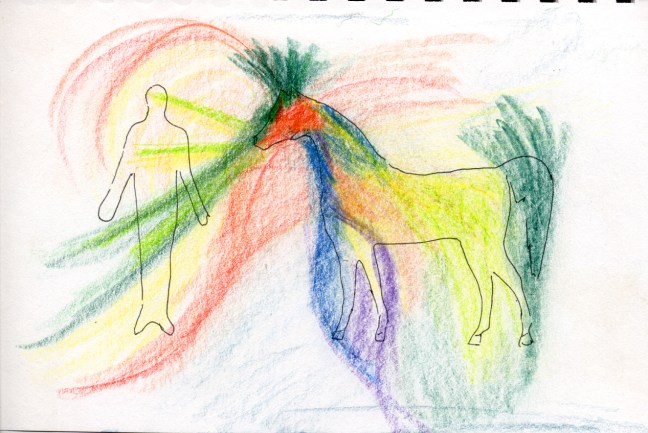
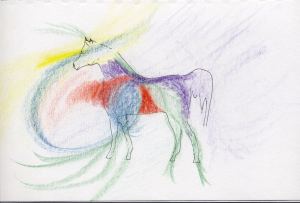
Here is a coloring I did of  ‘Jhana recently

colorjhanaIt helped remind me of what a remarkable being she is, the strength of her intention, her HUGE heart, the way she inhabits space through a loyal and dependable presence, the lightness of her back end, the power through her loins, and her rootedness in the earth, especially true to green of germination, renewal and spring.
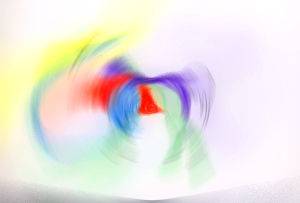
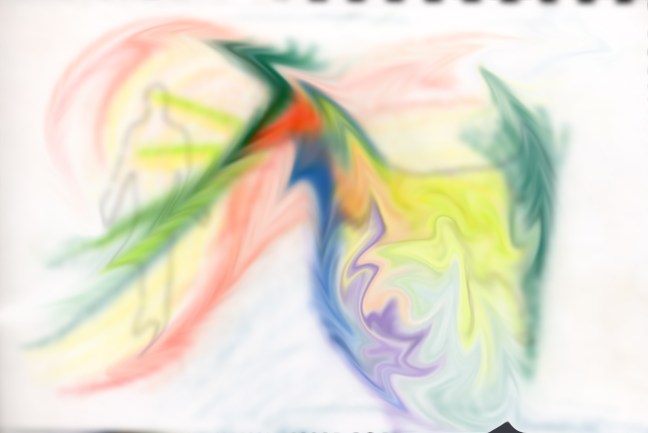
Through digital technology, I can get the image closer to the feeling of her energy field:

jhanaenergy