

This is something I say and write over and over again:
The Rider has No Right to the Horse’s Head!
Recently I have been asked by Kim over at enlightenedhorsemanship.net to expound on this in my own post. So here goes.
I believe that a person has no right to a horse’s head. The tendency for people to focus on the horse’s head, rather than on his body and feet, is engrained in both horsepeople and non-horsepeople alike. In workshops on liberty training, I teach the importance of precise body language. When trying to move the horse in one direction or another, too many people concentrate on the horse’s head — waving their hands at the horse’s nose and face, instead of thinking about how the horse’s body needs to move, and using your own body expressively in a manner that communicates this.
When riding, the situation becomes more exasperated, since too many people (like myself) have learned the wrong kind of “equitation.” There is too much talk about getting the right “look” at the poll, instead of understanding what the horse needs to be doing with his body. To me this is the same as as if a trainer had seen beautiful ballet at the theatre, and then began teaching ballet by using bungi cords suspended from the rafters to teach students how to achieve the rising and swirling of the head. The cause and the effect are mixed up. The ballerina’s head rises and swirls as an effect of what her legs and body are doing.
Similarly, head carriage in a high-schooled horse, should be an effect of proper conditioning and training of the horse’s feet, back, and body. This is the teaching that the student requires:
Setting the head with the bit, reins, and other technologies, and forcing the horse into a frame, quickly injures the horse’s neck, back, and spirit. The work is painful and disheartening to the horse. The result is a fictionalized illusion of classical dressage — however many points the student amasses at the shows.
What then is the relationship between the horse’s legs and his head carriage in early schooling? On the lunge, the trainer helps developi the horse’s balance at the various gates, primarily by focussing on the inside hind leg and driving the momentum from that leg through the loins, back and forehand. The stronger and more supple the horse becomes, the more the inside hind leg tracks forward in a balanced way, liberating the forehand to take a long, low stride. As the stride develops power, impulsion and freedom (the opposite of forced frame) — the loin actually travels up from under the horse– and therefore, the poll rises freely.
The horse’s enthusiasm for the work is developed through cultivating his balance and freedom!
At the trot it illustrates like this: (train yourself to watch the inside hind leg- which is the one “closest” to you – as it travels more and more forward, liberating the forehand, and allowing the head to rise naturally):
Here is an excellent video of Klaus Hempfling and his stallion over time, developing carriage through body language.
Few of us have the talent to work exclusively with a horse this way. We rely on bits and other aids — being as soft as possible to communicate to the horse what to do with his feet. The inside rein works in rhythm with the inside hind leg, to create impulsion. At the rising trot, the rider rises in sync with the inside hind leg pushinc off and coming forward — to liberate the leg to come underneath. The horse is worked at a extended pace, and reaches for the bit as if it were in front of him. Working with a horse this way, you can feel him trying to find the “sweet spot” — that place of rhythm and balance which eludes the young horse. When the horse finds the “sweet spot”, it all comes together in a very liberating feeling. It produces joy in the horse and rider.
Here is a picture of my stallion, Khemancho at liberty. This is a nice trot for a young, unschooled horse. The second picture shows his natural classic carriage – as he brings his loins right up underneath himself.
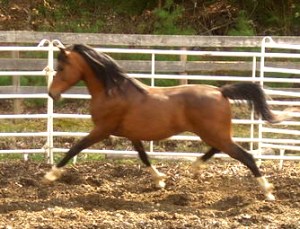
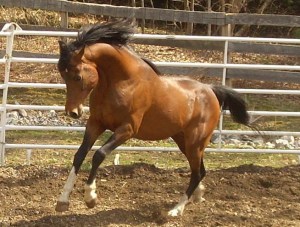
Under saddle it’s much more difficult for him, since he is still learning, and I am starting over myself hopefully with “Beginner’s Mind.”
Finally, here is a slideshow of Klaus and another stallion, that demonstrates the development of carriage. Watch for that inside hind leg, and see how the horse composes himself over time. This is exceptional for any horse to achieve. Why so many people burden their horse with the expectation of quick results, facilitated by an illusion based on force…. is a really good question.
Liberate yourself – set your horse free!
 The Horses at Alderlore Present