

Yesterday I had my chance to put into practice an idea I had about waltzing with ChoCho. Here is a video of our first trial run with music on the line, and then a short piece we did to music under saddle.
42 Meditations on Blueberry # 1
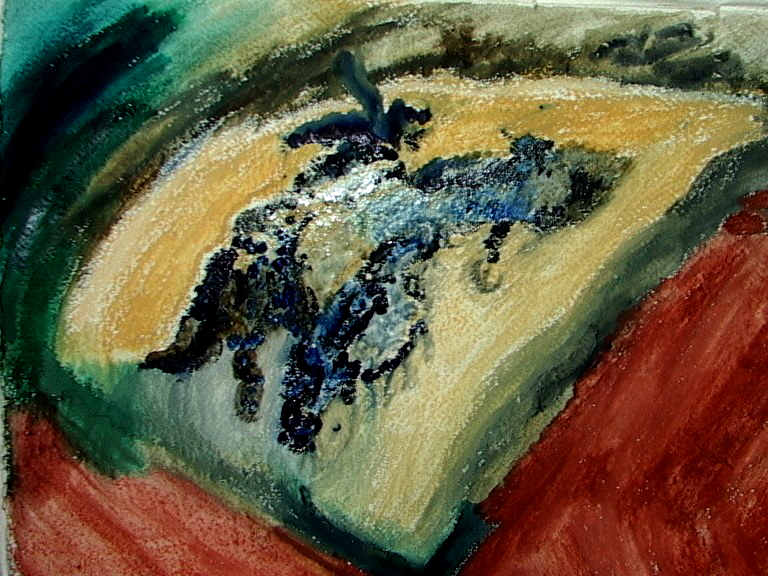
Two years ago, on the day that my youngest horse, Khemerro (aka Rio) was born, I received a blue beta fish as a gift at work. The fish now lives here at Alderlore. His name is Blueberry. Today I began a painting series (based on a dream I had last night) called 42 Meditations on Blueberry. Here is the product of the first meditation. Stay tuned for the rest!
The Rider Has No Right to the Horse’s Head
Karen Rohlf at Dressage Naturally (www.dressagenaturally.net) has a wonderful youtube video that demonstrates natural balance and head carriage in different types of liberty and riding play. I found her site to be wonderfully instructive.
Chickens Arrive at Alderlore!
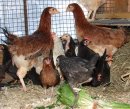
We received 12 wonderful rare breed chickens for Christmas! 3 Maran Hens (the large wheaten colored ones) who lay mahogany-red eggs, 6 Serama Hens – the tiny ones — they are the world’s smallest chickens and lay eggs that are perfect for pickling or cob salads; and three New Game Bantams — who look like chickens on stilts, or as we say in the video – velociptor raptors.
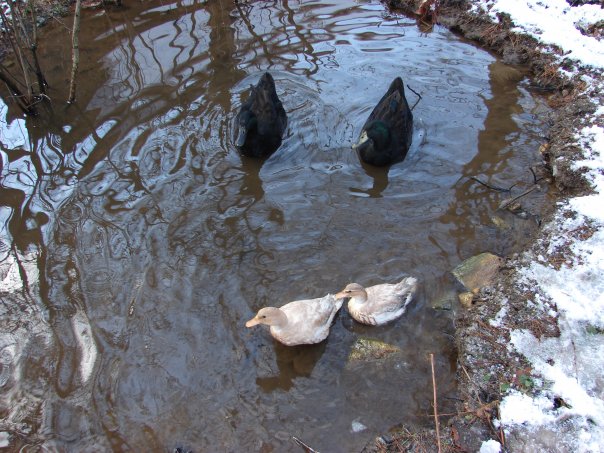
Oh! We also received 2 new fawn-colored ducks named Rosie and Ronnie. Thanks to Amy, here is a photo of them swimming with Drake and Drummer in the pond down by the barn.
Gallop to Freedom
I received the just-released book Gallop to Freedom by the Cavalia stars Magali Delgado & Frederic Pignon. Here are some wonderful quotes:
What people do not appreciate is that every time a horse submits to pressure, whether subtle or overt, he is diminished. Probably the great maajority of people who achieve their own ends by making their horse submit are not even aware of what they have done. It is a sad fact that a horse can be made to do many things by breasking his will. If he can be persuaded to give his assent freely and pleasurably rather than give into man’s pressure or clever techniques, he is not diminished.
Stallion Spirit
Yesterday was a beautiful Autum day. It was Sandy’s birthday. I took the day off, and Sandy, Amy and I trailered ChoCho and Hootch over to the horse park, Steep Rock. Hootch (the quarterhorse paint) thought it was a perfect day for relaxing. ChoCho & I took advantage of the rare opportunity for a good open space for him to race around in the sun, and celebrate his power, agility, grace & spirit… > Let’s go to the video tape!
How to Catch a Horse – Permission, Reward, Punctuation
The second component in learning how to catch a horse involves observing the horse’s reaction to your approach. You look for “permission” — in the horse’s manner, attitude, and in his eye. Here is how it goes:
During your approach, the horse will begin to notice that you and he are “joined” up. You might need to manage this if your horse is in a herd with other horses. If your horse is the dominant horse — no problem. You just work on joining up with him directly. If your horse is being chased by a dominant horse, there are two scenarios to choose from. If your horse prefers you over the dominator — you work on joining up with your horse and driving the dominator away. If your horse prefers to follow the dominator — you have to join up with the dominant horse first, then approach your horse with him.
During approach work, your horse will begin to slow down and stop. When the horse stops, you turn directly toward his barrel and deliberately walk toward him. Not hurredly, but deliberately. When he looks at you, you have to observe if he looks unsure (tense, skeptical eye) or if he is expressing “permission” (relaxed on his feet, soft eye). If he is tense, you pull back and turn parallel in the join-up position. If he is expressing “permission” to do so, you continue to walk straight up into his barrel.
(If he moves on, you simply start over with your approach.)
When you reach your horse, you do NOT go into automatic mode. Remind yourself what you have just communicated to your horse : a sense of affection, bonding, join-up, and respect for his permission. Reward this with soft, gentle patting along his withers and middle. Then raise the halter and look for (continued) permission. Put the halter on. THEN DO NOT RUSH OFF! Pay more attention to the relationship you are building. Take at least 30 seconds (count if you need to!) to scratch, pet, and touch your horse– on both sides. At then end, draw a slow long pat over the top line of your horse, and then another one along the bottom line. This is the kind of affection the mother horse gives her foal that brings her foal nearer to her (usually when she wants to be milked).
Finally, be mindful all through your approach. permission, and reward phase how you are handling the halter and any tack you are carrying/ wearing. The halter should be held in both hands (the left hand carrying the halter part, and the right hand carrying the lead rope) across the plane of your body. If you carry it off to the side, you will be giving incoherent signals — a bonding signal and a driving signal). Make sure you use the halter as an extension of your body, in a soft, inviting way. Don’t make it “about” the halter. Keep it “about” relationship.
Lastly, signal to your horse when it’s time to go to work. Say something (out loud or internally) like “That was nice, thank you. Now let’s just get to work.” Punctuating the transition between relationship and work (or sport, or having to see the vet or farrier) builds trust in your horse because you will be more coherent overall.
How to Catch a Horse – Approach
If you watch the previous video closely, you should see that the mare and her filly always move in parallel. You can see that no matter where they are running, how close or far apart they are, or what turns they make, they arrange themselves like this. Similarly, when approaching your horse, you should arrange yourself so that you are always parallel to the horse.
This position is the natural bonding position between horses. Just walking with your horse in this relationship of bodies creates a kind of resonate morphic field and will result in a significant difference in your horse’s attitude. Try it! It draws on the natural instincts of horses. Some horses have lost much of their instincts. Horses that have not spent enough time with their mothers, and have been raised in box stalls and paddocks all their lives, away from herd relations, are more difficult to bring around (see A Friesian’s Journey on the Path). But most horses — if they have lived a relatively “normal” life, can dig down into their past experience with their mothers, and understand what you are communicating here.
A few years ago I was interviewing for a horse -human teaching job. The horse in question was a spunky shetland pony. As I stood in the ring with the horse’s owner, talking about the horse and her daughter (the human part of the equation), the little pony ran around the ring, tossing his head, refusing to be caught. While I was talking, I kept making these little adjustments to my body, turning this way and that, depending on the angle and direction the pony was going. A couple of minutes later that pony was standing by my side “at attention” as if to say “ok, what do you want to do?” … and the owner was dumbfounded. Needless to say, I got the job.
If your horse is in a big wide field, you don’t have to keep up with him. You just have to keep walking with him, even from far across the pasture, in a way that keeps the plane of your body parallel to the plane of his. If the horse is turning inside to you, all you have to do is circle inside with him. If the horse takes a big bold, outside turn, you do not have to chase to the other side. Watch the video of the mare and her foal again. When the foal cuts to the outside, the mare “crosses over” and turns once again inside.
A person cannot keep pace with a horse. While approaching, then, you must create a “virtual path” to follow. Here is a diagram:
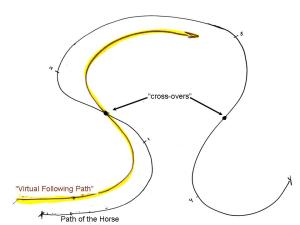
The black line is the path of the horse. The yellow line is the path you would be taking, if you could keep pace with a horse running in an open field. Even if you could, there is no need to do so. To create a bonding situation, all you have to do is follow the virtualfollowing path with your body language.
You might almost just pivot in place like I did with the pony. Here is an illustration of the actual path you would take: 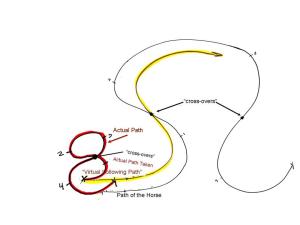
From the above illustration you can really see that the person actually crosses over his own path, though the person and the horse only cross-over “virtually”.
How to Catch a Horse
There are a lot of good techniques and sound advice on the topic of How to Catch a Horse. My approach helps contextualize or explain why some are more or less true, while others are more or less “wives tales.” My approach is based on observing herd behavior in horses, and interacting with a small herd of horses in an 80 acre open field for over 20 years. The foundation of this approach is the same as the body language that establishes a bond between you and your horse — or even between you and a horse you’ve never met before.
I do not recommend “pretending” that you do not want to catch your horse. Why would you want to establish that kind of duplicitous relationship with your horse? There is a kind of disconnect in this thinking that produces incoherence. You can feel the incoherence in your own mind as it tries to think what it isn’t thinking, mean what it doesn’t mean, and feign something that is not truly going on. This kind of incoherence the horse rejects.
The second kind of disconnect the horse rejects is incoherent body language. Few people understand how much we communicate to the horse with our body language. The horse is very keyed into the angle of our approach, the tilt of our shoulder, the expression/ angle of our hips, the cadence of our step.
Third, how we present ourselves to the horse, vis-a-vis the halter, rope and/or tack must also be coherent with what we are asking.
And finally, there is follow-through– what we do in the first 30 seconds (not to mention the next 30 years!) after we catch the horse is very important.
I would like to address each of these points individually. In practice they come all as a whole, but in this format, we need to dissect them one by one. Out goal will be to take all these individual skillsets and combine them seamlessly into one coherent whole — which will naturally attract the horse to us.
Lets start by watching a video of a mare and her filly. What do you see?
The Rider has NO RIGHT to the Horse’s Head!
This is something I say and write over and over again:
The Rider has No Right to the Horse’s Head!
Recently I have been asked by Kim over at enlightenedhorsemanship.net to expound on this in my own post. So here goes.
I believe that a person has no right to a horse’s head. The tendency for people to focus on the horse’s head, rather than on his body and feet, is engrained in both horsepeople and non-horsepeople alike. In workshops on liberty training, I teach the importance of precise body language. When trying to move the horse in one direction or another, too many people concentrate on the horse’s head — waving their hands at the horse’s nose and face, instead of thinking about how the horse’s body needs to move, and using your own body expressively in a manner that communicates this.
When riding, the situation becomes more exasperated, since too many people (like myself) have learned the wrong kind of “equitation.” There is too much talk about getting the right “look” at the poll, instead of understanding what the horse needs to be doing with his body. To me this is the same as as if a trainer had seen beautiful ballet at the theatre, and then began teaching ballet by using bungi cords suspended from the rafters to teach students how to achieve the rising and swirling of the head. The cause and the effect are mixed up. The ballerina’s head rises and swirls as an effect of what her legs and body are doing.
Similarly, head carriage in a high-schooled horse, should be an effect of proper conditioning and training of the horse’s feet, back, and body. This is the teaching that the student requires:
Setting the head with the bit, reins, and other technologies, and forcing the horse into a frame, quickly injures the horse’s neck, back, and spirit. The work is painful and disheartening to the horse. The result is a fictionalized illusion of classical dressage — however many points the student amasses at the shows.
What then is the relationship between the horse’s legs and his head carriage in early schooling? On the lunge, the trainer helps developi the horse’s balance at the various gates, primarily by focussing on the inside hind leg and driving the momentum from that leg through the loins, back and forehand. The stronger and more supple the horse becomes, the more the inside hind leg tracks forward in a balanced way, liberating the forehand to take a long, low stride. As the stride develops power, impulsion and freedom (the opposite of forced frame) — the loin actually travels up from under the horse– and therefore, the poll rises freely.
The horse’s enthusiasm for the work is developed through cultivating his balance and freedom!
At the trot it illustrates like this: (train yourself to watch the inside hind leg- which is the one “closest” to you – as it travels more and more forward, liberating the forehand, and allowing the head to rise naturally):
Here is an excellent video of Klaus Hempfling and his stallion over time, developing carriage through body language.
Few of us have the talent to work exclusively with a horse this way. We rely on bits and other aids — being as soft as possible to communicate to the horse what to do with his feet. The inside rein works in rhythm with the inside hind leg, to create impulsion. At the rising trot, the rider rises in sync with the inside hind leg pushinc off and coming forward — to liberate the leg to come underneath. The horse is worked at a extended pace, and reaches for the bit as if it were in front of him. Working with a horse this way, you can feel him trying to find the “sweet spot” — that place of rhythm and balance which eludes the young horse. When the horse finds the “sweet spot”, it all comes together in a very liberating feeling. It produces joy in the horse and rider.
Here is a picture of my stallion, Khemancho at liberty. This is a nice trot for a young, unschooled horse. The second picture shows his natural classic carriage – as he brings his loins right up underneath himself.
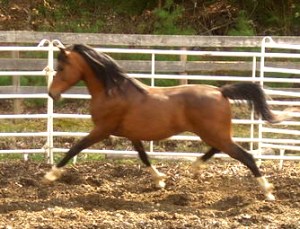
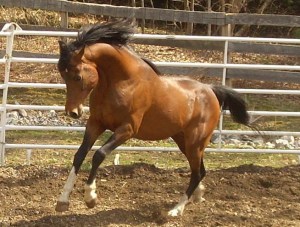
Under saddle it’s much more difficult for him, since he is still learning, and I am starting over myself hopefully with “Beginner’s Mind.”
Finally, here is a slideshow of Klaus and another stallion, that demonstrates the development of carriage. Watch for that inside hind leg, and see how the horse composes himself over time. This is exceptional for any horse to achieve. Why so many people burden their horse with the expectation of quick results, facilitated by an illusion based on force…. is a really good question.
Liberate yourself – set your horse free!
 The Horses at Alderlore Present